INSIGHTS
Strategy
What Actually Changes My Market Posture
How trend, participation, leadership, setup quality, and position feedback shape exposure.
For a long time, I thought I needed to have a strong opinion on the market. Bullish or bearish. Risk-on or risk-off. Press the gas or sit in cash.
The longer I have traded, the less useful that framing has become. Markets rarely improve or deteriorate all at once. The indexes can look healthy while participation weakens underneath the surface. Leadership can begin repairing before the averages confirm it. Setups can start appearing everywhere and still fail to produce durable trends.
I have become much less interested in what I think the market should do. I care more about what the evidence is actually telling me.
A large part of my process has been shaped by traders and investors including Jesse Livermore, William O'Neil, Nicolas Darvas, Stan Weinstein, and Mark Minervini, along with traders and educators who have built on many of those same principles through communities like TraderLion and DeepVue.
The terminology changes, and the tools available today are obviously different from those available to Livermore or Darvas. But many of the underlying ideas have stayed remarkably consistent: respect the primary trend, focus on leadership, let price confirm the thesis, concentrate when conditions are favorable, protect capital when they are not, and do not force the market to agree with what you think should happen.
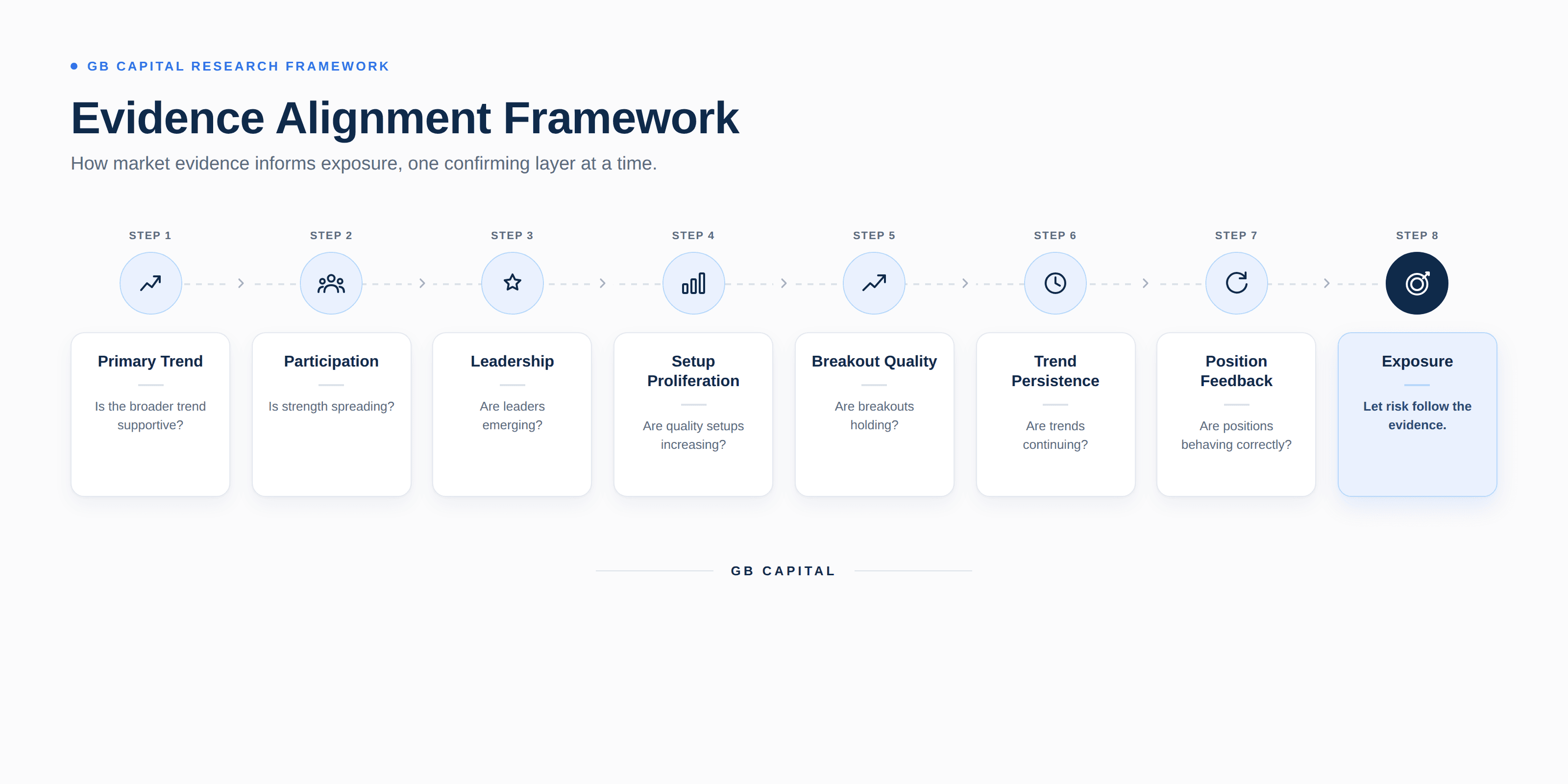
Over time, I have come to think about all of this as Evidence Alignment.
The Market Has to Earn Exposure
There is no single indicator that tells me when it is time to become more aggressive.
The S&P 500 can sit above its 21-day moving average while plenty of individual stocks deteriorate underneath the surface. Breadth can improve while the highest-quality leaders stay stuck in bases. Setups can begin forming everywhere, but if those setups repeatedly break out and fail, the opportunity set is not as strong as it looks.
The opposite can happen too. Headlines can stay uncomfortable while individual stocks quietly start improving. Former leaders stop going down, new leadership appears, more stocks transition into constructive Stage 2 trends, watchlists expand, breakouts start holding, pullbacks get shallower, and positions begin behaving better. At some point, those observations start adding up to something more important: the environment is changing.
My objective is to recognize that change without requiring myself to predict it in advance. I do not need to identify the exact bottom of a correction, know where the S&P 500 finishes the year, or hold the perfect view on inflation, interest rates, AI spending, the Federal Reserve, or whatever macro debate happens to dominate the market at the time.
Those things matter. But if the market is becoming healthier for the type of stocks I want to own, I should begin seeing evidence of it.
The market has to earn greater exposure.
Start With the Primary Trend
Stan Weinstein's stage analysis has had one of the clearest influences on how I organize the market.
A stock advancing above rising longer-term moving averages should not be treated the same way as one declining below falling moving averages simply because both happen to look inexpensive or interesting. That sounds obvious, but it has enormous implications.
The first question is not whether something is overbought, oversold, cheap, expensive, loved, hated, or likely to beat next quarter's earnings estimate. The first question is: What is the trend?
For the broader market, I start with the structure of the major indexes and where they sit relative to important intermediate and longer-term moving averages. That establishes the backdrop, but it is only the backdrop. One of the biggest mistakes I can make is allowing index strength to substitute for evidence underneath the surface.
An index can stay healthy because a relatively small number of very large companies are working. That does not necessarily mean the environment is producing a large number of attractive opportunities. The indexes tell me whether the broader trend is supportive. The individual stocks tell me whether opportunity is actually expanding underneath it.
Participation and Leadership Tell Me Whether the Move Is Broadening
This is where breadth and stage participation become much more useful.
I want to know whether strength is spreading. Are more stocks moving into constructive Stage 2 trends? Is Stage 4 participation contracting? Are more industries beginning to participate, or is strength becoming increasingly concentrated in a handful of names?
None of those measures needs to be perfect. Waiting for every indicator to line up would mean waiting until much of the opportunity had already passed. What matters is the direction and quality of the evidence.
A market where Stage 4 deterioration has stopped expanding is different from one where it is accelerating every week. A market where Stage 2 participation has stabilized is different from one where constructive trends are beginning to spread across multiple groups. Markets often improve incrementally before the improvement becomes obvious, which is why I care so much about what is happening beneath the indexes.
William O'Neil's work and the CAN SLIM framework reinforced something that has become central to how I think: real market leadership is information.
I want to see stocks with strong relative strength, institutional-quality liquidity, meaningful fundamental or thematic drivers, and price action showing sustained demand. More importantly, I want to see more of them.
One great stock can always exist in a mediocre environment. Ten or twenty emerging leaders across several groups begin telling a different story. The indexes summarize the market. Leadership shows me where capital is actually concentrating.
Setups Are Evidence, Breakouts Are Confirmation
One of the most useful changes in my process has been paying attention to setup proliferation. My watchlist itself contains information.
When conditions are poor, I can spend hours screening and still struggle to find stocks I would genuinely want to own. Structures are loose, relative strength is inconsistent, former leaders are damaged, and potential breakouts require too many exceptions.
Then, sometimes almost without noticing it at first, the list begins growing. More stocks tighten up. More leaders form constructive bases. More names move from a broad watchlist toward what I consider High Alert.
That is meaningful, but this is also where I have learned to be careful. A market producing attractive charts is not necessarily a market producing profitable trends. The setups still have to work.
If a healthier opportunity set is developing, I should eventually see stocks emerge from those structures and behave the way strong stocks are supposed to behave. Breakouts hold, relative strength stays firm, pullbacks find support, and stocks spend more time above key short-term moving averages than below them.
There is a major difference between a stock that breaks out eight percent and gives it all back three sessions later and one that breaks out, consolidates the gain, and keeps working higher over several weeks. Both looked good on breakout day. Only one became the type of trend I am actually looking for.
Mark Minervini has written extensively about demanding strong price behavior and keeping risk well defined, while O'Neil's work puts similar emphasis on whether leading stocks behave correctly after breaking out.
The lesson I take from both is simple: the market does not get credit for what looks like it should work. It gets credit for what actually works.
My Own Positions Are Part of the Evidence
Eventually, I have to stop looking only at screens and see what happens when real capital is exposed to the market. Actual positions give me information no breadth indicator or dashboard can completely replicate.
Are my best setups immediately stopping me out? Am I constantly managing reversals? Do positions get a few percent above my entry and stall, or are the strongest stocks making progress, holding gains, and rewarding patience?
Livermore wrote about the importance of being right and then sitting tight. Darvas built much of his success around staying with stocks that continued confirming his thesis through price behavior. That part has become increasingly important to how I think about exposure.
There will always be failed trades and false breakouts. Nothing works perfectly. But collectively, strong conditions produce better feedback. When the environment is healthy, I should not have to fight every position.
That feedback gives me permission to gradually increase risk. The process becomes self-correcting. I take selective exposure because the evidence is improving. If those positions start working, the market provides additional confirmation. If they repeatedly fail, I have learned something before the original thesis turns into a much larger portfolio problem.
Exposure Should Be the Output
This is the biggest change in how I think about market posture. Exposure should be an output of the process, not an input.
I do not want to decide I am bullish and then search for reasons to become fully invested. I want the evidence to pull me into the market.
Primary trend. Participation. Leadership. Setup proliferation. Breakout quality. Trend persistence. Position feedback.
As more of those begin aligning, I become more aggressive. When they begin separating, I become more selective. When enough of them deteriorate together, capital preservation becomes more important than finding the next opportunity.
There is no perfect formula for this, and that is important too. Markets are too dynamic for seven green boxes to automatically mean maximum exposure or three red boxes to automatically mean cash.
Sometimes leadership improves before breadth. Sometimes the indexes repair before the stocks do. Sometimes setups proliferate before breakouts begin working. Sometimes the market produces outstanding individual opportunities despite mediocre index conditions.
Judgment still matters. The framework is not meant to eliminate judgment. It is meant to give judgment something objective to work from.
Evidence Over Prediction
One of the recurring lessons across almost every trader who has influenced me is that markets have a way of punishing certainty.
Livermore traded in a completely different era from O'Neil. Weinstein organized markets differently from Minervini. The tools available today through platforms like DeepVue would have been unimaginable to many of the investors whose principles they now help quantify.
Yet the same ideas keep showing up: find strength, respect trend, wait for confirmation, control risk, press when the evidence supports it, and back away when it does not.
Do not confuse an opinion with what the market is actually telling you.
My process will keep changing. I expect the tools I use, the way I measure participation, the screens I build, and even parts of my portfolio framework to keep evolving as I gain experience.
But the underlying principle is becoming much more permanent. I do not need certainty about what comes next. I need enough independent evidence aligning to justify taking risk, a clear way to recognize when that evidence is strengthening or deteriorating, and the discipline to let exposure follow accordingly.